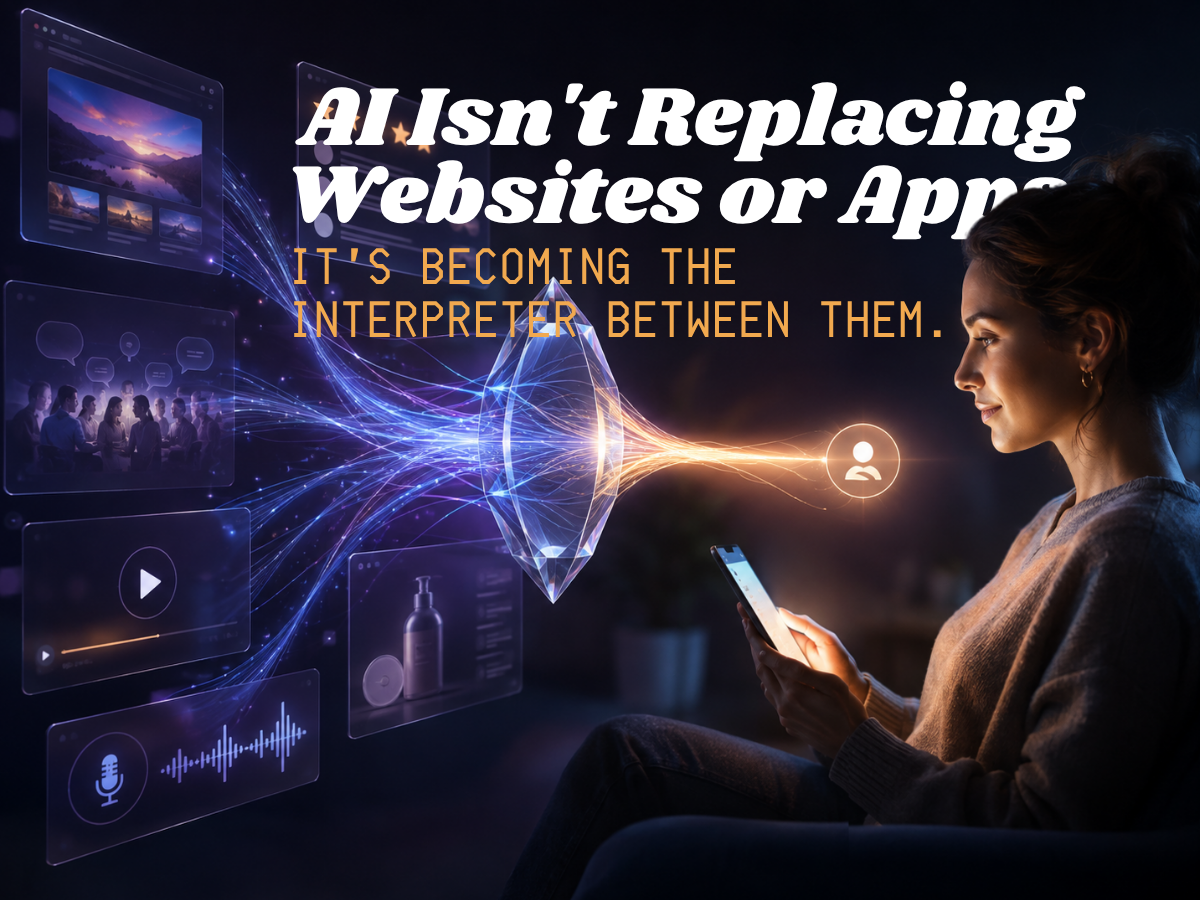
AI Isn't Replacing Websites or Apps. It's Becoming the Interpreter Between Them.
By Tom Reidy
Key takeaways
- AI interprets, not just retrieves, information.
- AI synthesizes data from multiple digital sources.
- Websites become information sources for AI.
- Being understood is key, not just being visited.
- AI transforms online decision-making processes.
For years, the digital world has been divided into distinct layers.
Websites existed to provide information. Apps existed to provide utility. Review platforms provided trust. Communities provided context. Each played a different role in helping people discover, evaluate, and choose products, services, and experiences.
When someone wanted to buy something, they would move between these layers. They might discover a business through a Google search, visit its website, check Trustpilot reviews, watch a YouTube video, browse a Reddit discussion, and ask a friend for their opinion before making a decision.
The internet became a giant collection of disconnected pieces that users had to manually assemble into confidence.
What is changing is not the existence of those layers. It is the emergence of AI as the interpreter between them.
For decades, search engines were largely retrieval systems. You asked a question and they returned a list of links. The burden of interpretation remained with the user. You had to decide which links to click, which reviews to trust, which opinions carried weight, and which information was relevant to your situation.
AI is beginning to change that relationship.
Instead of simply providing access to information, AI increasingly helps people make sense of it. It can read product descriptions from websites, analyse reviews from customers, consider discussions from communities, compare competing viewpoints, and present a synthesised recommendation based on the user's specific circumstances.
The important distinction is that AI is not merely finding information. It is interpreting it.
Consider someone looking for a running watch. A traditional search journey might involve reading product pages from Garmin, Coros, and Suunto, watching review videos on YouTube, browsing Reddit discussions, and reading customer reviews before eventually reaching a conclusion. The user acts as the interpreter, collecting information from multiple sources and attempting to make sense of it.
An AI-assisted journey is different. A runner might simply ask, "I'm training for my first ultra marathon, I have a budget of $1,000, and I care more about battery life than smartwatch features. What should I buy?" The AI can potentially draw on information from product specifications, expert reviews, customer experiences, and community discussions to provide a recommendation tailored to that person's needs.
The recommendation is no longer based on a single source. It emerges from the interpretation of many sources.
This changes the role of websites.
Historically, businesses focused heavily on attracting visitors to their own websites because that was where decisions were made. The website was the destination. Increasingly, however, websites may become one of many sources that contribute information to an AI-generated recommendation.
This means businesses are entering an era where being understood may become more important than being visited.
The same shift applies to review platforms. Trustpilot, Google Reviews, Reddit discussions, Facebook groups, and countless other community spaces exist because people seek independent perspectives. They want to know what real customers experienced, not simply what the brand claims. These platforms provide trust because they create a layer of interpretation separate from the organisation itself.
AI does not replace that trust. Instead, it consumes and analyses those signals alongside many others. Rather than reading hundreds of reviews, a person may ask an AI assistant to identify the common strengths and weaknesses reported by customers. The assistant becomes a filter for collective experience.
In many ways, AI is transforming the internet from a collection of destinations into a network of evidence.
Websites provide evidence.
Reviews provide evidence.
Communities provide evidence.
Videos provide evidence.
Podcasts provide evidence.
AI's role is to assemble, interpret, and explain that evidence in a way that is relevant to the individual asking the question.
This has profound implications for marketers and businesses. For years, digital strategy has largely focused on driving traffic. Success was measured by visits, clicks, impressions, and time on site. While those metrics will continue to matter, a new challenge is emerging: ensuring your brand is represented accurately within the information ecosystem that AI uses to form recommendations.
The businesses that succeed in this environment will not simply create more content. They will create clearer, more useful, and more trustworthy information. They will encourage genuine customer advocacy. They will invest in communities. They will share expertise openly. They will understand that every article, review, video, and customer interaction contributes to the body of evidence that shapes future recommendations.
The internet is entering a new phase. Websites remain important. Apps remain important. Reviews remain important. Communities remain important.
What is changing is how people interact with them.
Instead of visiting each destination individually, users are increasingly asking an interpreter to guide them.
The future of digital marketing may not be about ranking first in search results or building the most sophisticated app. It may be about becoming the most trusted source within the ecosystem that AI uses to understand the world.
Because in an AI-driven future, visibility will still matter. Trust will still matter. Context will still matter.
The difference is that AI will increasingly be the bridge that connects them all.