The Future of Devices
By SocialMediaNZ

The Future of Devices
1 Sept
Written By Tom Reidy
Edge Nodes for AI Inference
It’s an easy prediction to make: devices as we know them are about to change forever.
For decades, we’ve swung between two poles of computing: powerful local machines and thin clients tethered to the cloud. But the rise of artificial intelligence is creating a new paradigm. Devices will no longer be defined by how many apps they run or how much storage they hold. Instead, they’ll serve as edge inference nodes for AI, sitting at the intersection of local processing power and cloud intelligence.
Why Not Just Run Everything in the Cloud?
On the surface, pushing all AI workloads to the cloud might seem more straightforward. Hyperscale data centres already train the largest models, so why not let them handle inference too? The answer lies in three practical limitations:
-
Bandwidth Bottlenecks
Sending huge amounts of raw data (video, audio, sensor streams) to the cloud for processing simply isn’t sustainable. Even with 5G, Starlink, and future networks, bandwidth has hard limits.
-
Latency Sensitivity
Some AI tasks, like self-driving cars making split-second decisions, AR glasses overlaying live data, or voice assistants that feel conversational, require responses in milliseconds. Cloud round-trips can’t guarantee that.
-
Data Privacy and Cost
Offloading every bit of personal data upstream isn’t just expensive, it’s risky. Local inference keeps the most sensitive information, like health metrics, financial data, or private conversations, on the device.
The Edge–Cloud Partnership
The future will be a hybrid model:
- Training in the Cloud
Large foundation models are trained on immense clusters, constantly evolving.
- Inference at the Edge
Devices receive optimised, distilled versions of these models (quantised, pruned, or fine-tuned) and run them locally with NPUs and AI accelerators.
- Selective Offloading
When tasks exceed a device’s capabilities, only compressed summaries or embeddings are sent to the cloud, minimising bandwidth usage while still tapping into deeper intelligence.
Implications for Devices
This shift changes how we think about hardware, software, and user experience:
-
Hardware: Expect every phone, laptop, and wearable to include specialised neural processors. Apple’s M-series, Qualcomm’s AI-optimised Snapdragon chips, and Nvidia’s edge GPUs are just the beginning.
-
Software: Applications will be built for split inference, deciding dynamically based on conditions whether to run locally or remotely.
-
Ecosystem: Companies that balance privacy, power, and performance across cloud and edge will shape the next era of personal computing.
-
User Experience: Devices will feel more responsive, more personal, and far less dependent on constant connectivity.
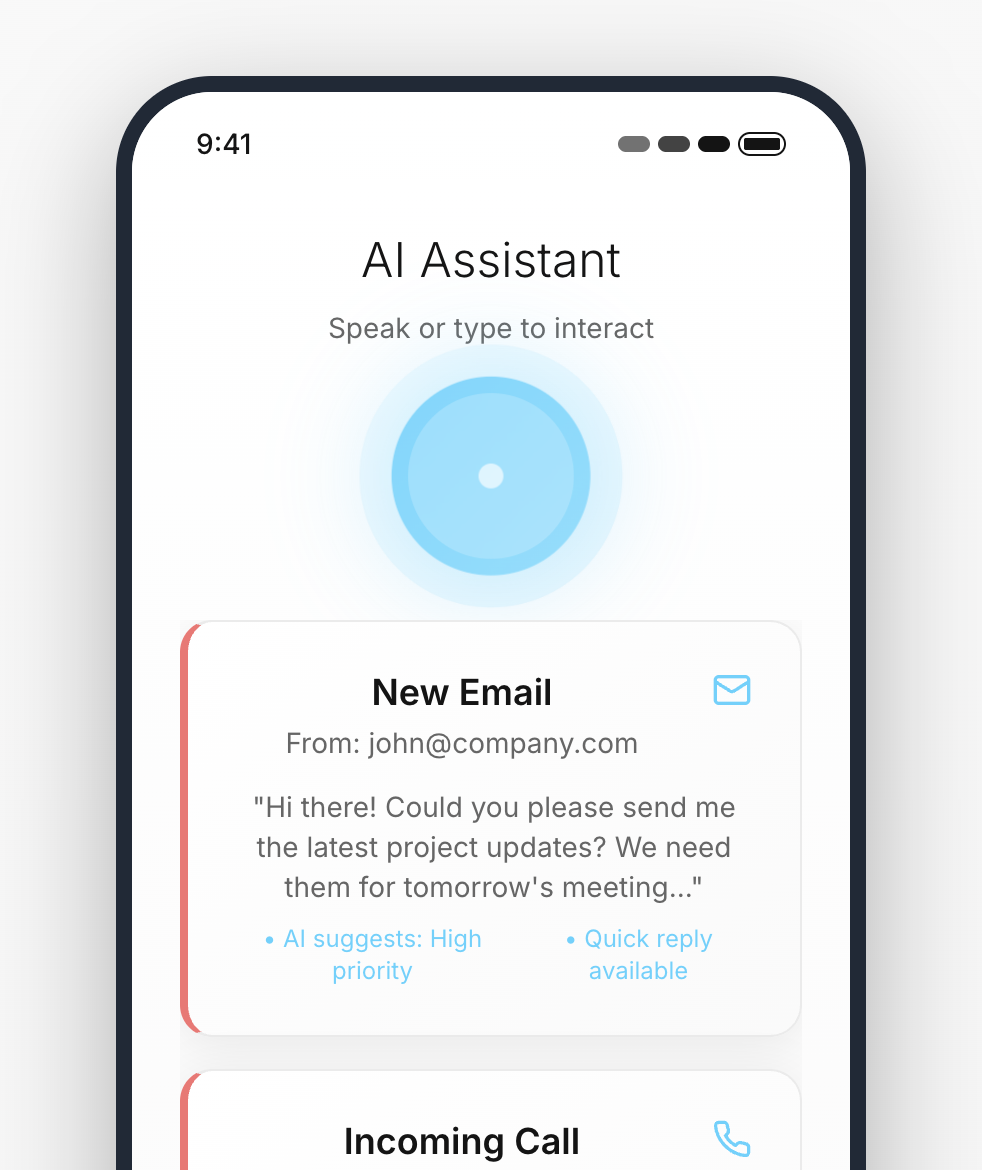
NotioFlux
AI-First OS: The future of smartphone interaction
NotioFlux is an imaginative exploration of what an AI-first operating system could look like in the future of smartphone interaction. Instead of relying on static app grids and traditional navigation, the concept envisions a device that responds through natural conversation, adaptive interfaces, and contextual intelligence.
The mock-up suggests a home screen that reshapes itself around your needs: surfacing actions, reminders, or content before you actively search for them. Interaction would be multimodal, blending voice, gestures, and ambient awareness, all powered by on-device AI inference for privacy and speed. While NotioFlux isn’t a real OS today, it sparks a vision of a world where the smartphone becomes less of a tool you command and more of a companion that anticipates and supports your intent.
What This Means for Us
We are entering an age where devices will no longer be tools for accessing apps; they’ll be AI companions, always present, always learning, and always ready to infer meaning from the world around us. The cloud will remain the backbone of training and orchestration, but the intelligence we experience day-to-day will come from the edge.
The prediction is simple, but the implications are profound: Your phone, laptop, and car aren’t just gadgets anymore. They’re becoming your personal AI nodes.
Tom Reidy https://www.tomreidy.com
Comments (0)
Newest FirstOldest FirstNewest FirstMost LikedLeast Liked
Preview
Post Comment…
Previous\
\
Previous\
Brands Slide into Your DMs Next\
\
Next\
\
Meta’s Superintelligence Labs and the Future of Social Media
reCAPTCHA
Recaptcha requires verification.
protected by reCAPTCHA