The Race Is No Longer for Technology. It's for Customers.
By Tom Reidy
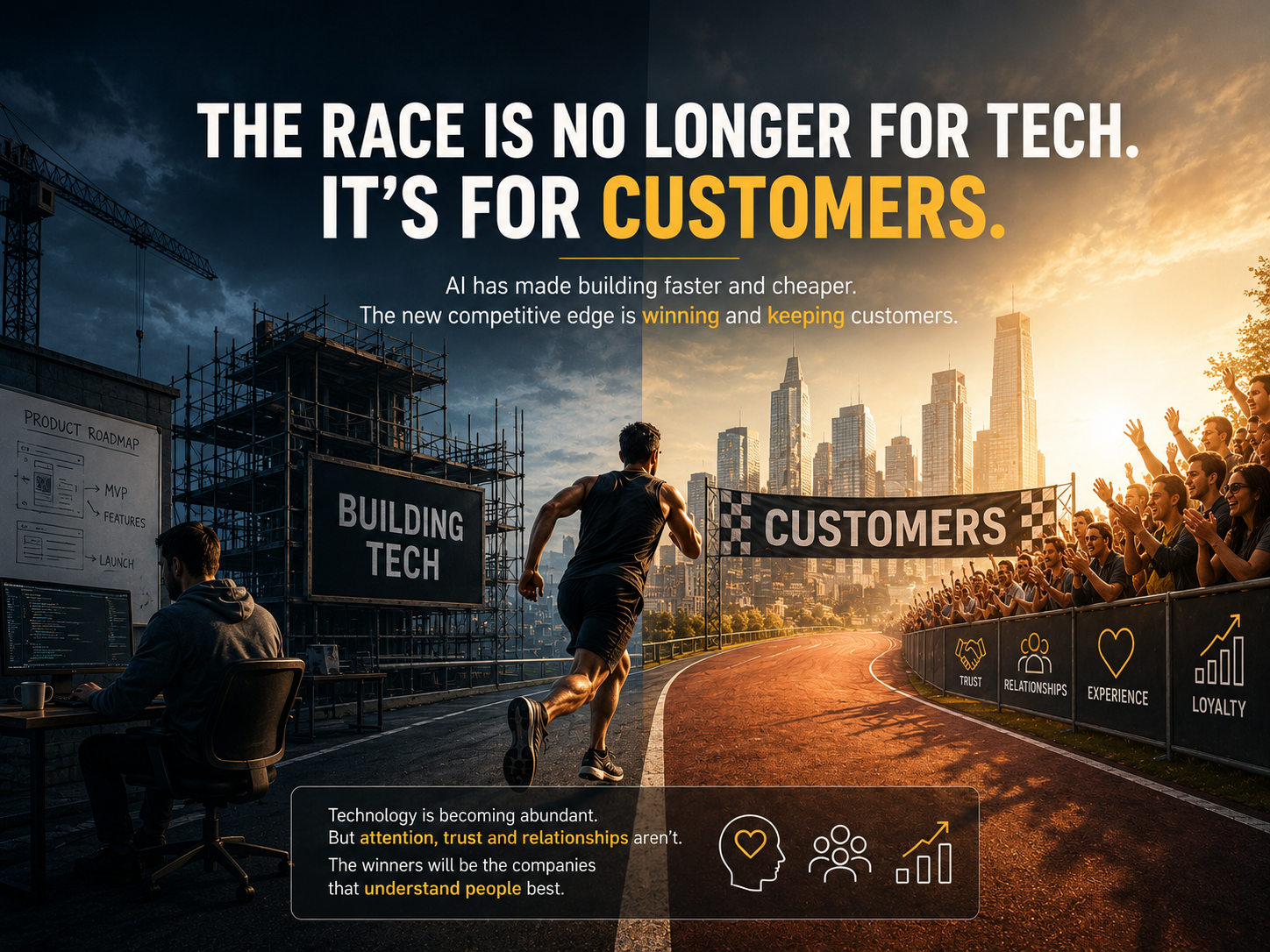
Key takeaways
- AI collapses software development costs.
- Customer acquisition is the new competitive 'moat'.
- Focus shifts from building tech to market & retention.
- Customer experience and trust are now paramount.
For decades, one of the biggest barriers to launching a technology company was relatively simple: you had to build the technology.
And building technology was expensive. You needed developers, designers, infrastructure, project managers and months — sometimes years — of development before you could properly test an idea in the market.
That created a natural barrier to entry. If you had the capital, technical capability and time to build something other people couldn't, you had an advantage.
AI is rapidly dismantling that advantage.
The cost of building is collapsing
AI hasn't eliminated software developers, nor has it eliminated the need for good architecture, security, testing or experienced technical thinking. But it has dramatically changed what a small team can accomplish.
The 2025 Stack Overflow Developer Survey found that 84% of respondents were already using or planning to use AI tools in their development process, with 51% of professional developers using them daily. AI-agent users were also reporting significant productivity improvements.
When productivity increases, the economics of creating software change. Ideas that might once have required a team of developers and substantial investment can increasingly be prototyped by one or two people. An MVP can potentially be created in days or weeks rather than months, features can be tested before committing significant resources, and entrepreneurs without traditional development backgrounds can increasingly turn ideas into functioning products.
The moat is moving. Having the ability to build something is becoming less remarkable. Having people who actually want it is becoming considerably more valuable.
Welcome to the age of infinite software
We could be entering an era of almost infinite software.
Think about what happened when social media dramatically reduced the cost of publishing content. Suddenly everyone became a publisher. The result wasn't less content; it was an explosion of content, and that created a new problem: attention became scarce.
AI development could create exactly the same phenomenon with software. When almost anyone can create an app, platform, SaaS product or digital service, the number of products competing for our attention increases dramatically.
The constraint moves. It is no longer simply, "Can we build it?" It becomes, "Can we get anyone to care?"
The race is now for customers
This fundamentally changes the startup equation.
Traditionally, a significant percentage of early investment went into creating the product. Increasingly, I think we'll see the balance move towards creating the market around the product — brand, content, community, distribution, advertising, partnerships, customer experience, sales, retention, trust and ultimately attention.
The expensive part of launching the next generation of technology businesses may not be developing the technology. It may be acquiring the customer — and once you've acquired them, keeping them.
CAC could become the new development cost
Customer Acquisition Cost — CAC — has always mattered. But imagine a market where ten competitors can reproduce broadly similar functionality relatively quickly. The technical advantage starts shrinking and the marketing battle intensifies.
If Company A can build its product for $50,000 and Company B can build something comparable for $20,000 using AI-assisted development, that sounds like an enormous advantage. But what happens when both companies need to spend $500,000 building awareness, generating leads and acquiring enough customers to create a sustainable business?
Suddenly, the cost of the code isn't the most interesting number. CAC is.
That's where marketing moves from being something that happens after product development to being fundamental to product strategy.
Distribution becomes a moat
For years we've talked about technology creating competitive moats through proprietary systems, complex infrastructure, unique features and technical IP. Those things aren't disappearing, particularly in sophisticated or highly regulated industries. But for a huge number of digital products, AI is making functionality easier to replicate.
If your competitor can reproduce your killer feature surprisingly quickly, the feature isn't much of a moat. A trusted brand, passionate community, thousands of happy customers, years of useful content, a strong social following, industry relationships, customer data, an engaged email database, an effective sales operation and a reputation are considerably harder to reproduce.
In other words, distribution becomes the moat.
You can ask AI to recreate a feature. You can't prompt your way to ten years of customer trust.
Retention becomes even more important
There's another side to this. If AI makes creating competing products easier, switching options multiply. Customers will constantly be presented with alternatives promising to be cheaper, faster, smarter or more AI-powered.
That means acquiring customers without retaining them becomes an incredibly expensive game. The businesses that win won't necessarily be those that generate the most sign-ups; they'll be the ones that build relationships strong enough that customers don't want to leave.
That requires more than technology. It requires customer service, listening, community, education, communication, continual improvement and, perhaps most importantly, delivering genuine value. The product gets someone through the door. The experience gives them a reason to stay.
Marketing needs to start before the product is finished
There's also a lesson here for founders: stop thinking of marketing as the thing you do once you've built your product. Start building the audience while you're building the product.
Talk about the problem. Create useful content. Build a community. Interview potential customers. Share what you're learning. Test your positioning. Grow your email database and understand the language customers use to describe the problem you're trying to solve.
You might discover something incredibly valuable before writing half the features on your roadmap: nobody actually wants them.
That's another advantage AI gives us. If software becomes cheaper to create and change, we can spend less time protecting what we've built and more time responding to what customers actually need.
AI doesn't remove the need for developers
There's an important distinction here. AI-assisted development isn't perfect.
Stack Overflow's 2025 research found developers were actually more likely to distrust the accuracy of AI tools than trust them, and 66% reported frustration with AI-generated solutions that were "almost right, but not quite."
Experienced developers, architects and technical leaders remain incredibly important. AI doesn't magically remove security, scalability, architecture, privacy or quality assurance. What changes is leverage.
A great developer equipped with AI can potentially accomplish far more. A small technical team can potentially operate like a much larger one, and founders can test concepts before investing heavily in production development.
The development industry isn't disappearing. It's becoming amplified.
The competitive advantage is shifting
For entrepreneurs, this should change how we think about starting businesses.
The question used to be, "Can we build this?" Then it became, "Can we build this better?" The next question might simply be, "Can we get customers?"
Technology is becoming abundant. Content is abundant. Software is becoming abundant. AI capability is becoming increasingly accessible. But attention isn't. Trust isn't. Relationships aren't. Customers aren't.
That means the winners of the AI revolution may not necessarily be the companies with the cleverest technology. They may be the companies that understand people better than everyone else — the companies that build communities, tell better stories, solve real problems and create brands people trust.
Ultimately, it comes back to something marketers have known for a very long time: building something is only half the battle. Getting someone to care about it is the other half.
And in the age of AI, that second half might become the most valuable part of the entire business.